E-mail Us at info@wingtupet.com
Call Us at Wingtu Pet | Whatsapp +1- 626 734 5510

Get A Quote
We have all been there. You order a new piece of gear online. You unbox it. You spend twenty minutes fiddling with the straps while your pup wiggles around. It looks okay. But is it?
In the new year, we should have a better understanding of this. A harness isn’t just a rope to keep your dog from running away. It is orthopedic equipment. If it sits wrong, it can hurt. It can change how your dog walks. It can even cause long-term joint issues.
You don’t need a degree in physics to figure this out. You just need to watch your dog.
Forget the complex diagrams for a minute. Here is the ultimate dog harness fit guide. Look for these three simple “red flags.” If you see them? It is time to adjust the straps. Or maybe, it is time to buy something new.
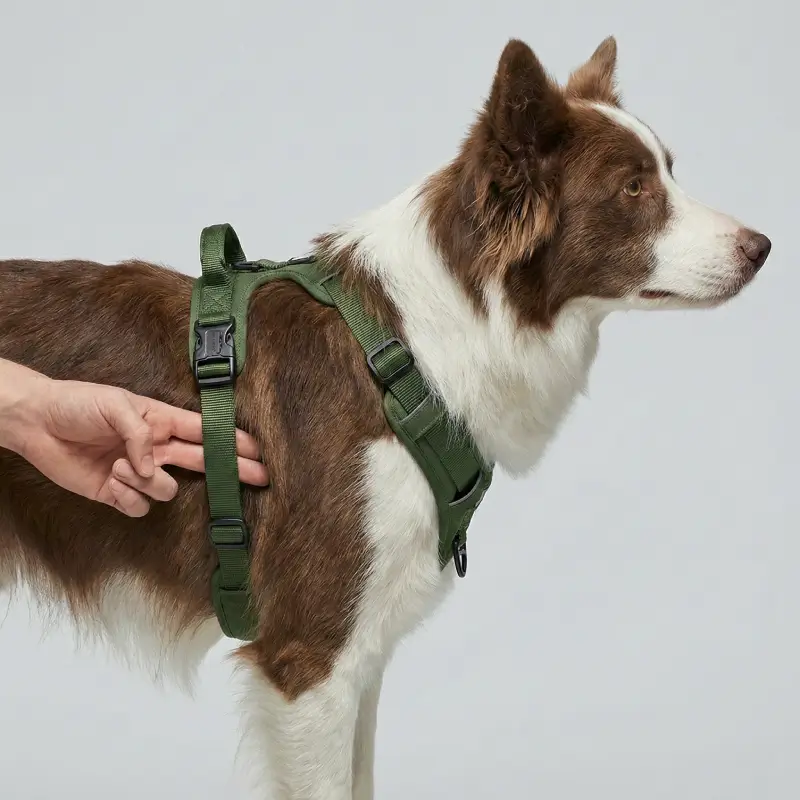
1. The “Armpit Test” (Watch for the Rub)
This is the big one. It is the most common problem I see at the dog park.
If the harness sits too close to the front legs? It rubs. Every single step creates friction. Imagine walking five miles with sandpaper tucked under your arms. Ouch.
How to check: Look at the space right behind your dog’s front legs. This is the axilla area. You want a gap here. A clear gap.
You should be able to fit roughly two fingers between the back of their front leg and the harness strap.
- The Problem: If that strap digs in, you get dog harness chafing. You might see red skin. Or missing fur.
- The Fix: This is why so many people love Y-harness benefits. Good ones sit further back on the ribcage. They stay away from the sensitive armpit zone.
2. The “Side-Slip” (Is it Floating?)
Does the harness slide sideways every time you clip on the leash? Does the chest plate gap open when your dog puts their nose down to sniff?
That is a bad sign. It means the fit is unstable.
How to check: Do the “Two-Finger Rule.” But do it on the neck and the chest straps. You should be able to slide two fingers under the strap. It should feel snug. Like a firm handshake. It should not slide around loosely.
- Winter Note: It is February. Is your dog wearing a sweater? Remember this. You have to loosen the straps for the coat. A harness that fits perfect on bare fur might be way too tight over a fleece. Or, if you take the coat off, it might be dangerously loose.
- Why it matters: How tight should a dog harness be is a balance. If it rotates? It puts weird pressure on their spine when they pull. Keep it centered.
3. The “Short Stride” (The Hidden Danger)
This signal is subtle. But it is huge for health.
Some harnesses have a strap that goes straight across the chest. Horizontally. These are often sold as “no-pull” gear. They work by stopping the shoulders from moving forward.
How to check: Watch your dog walk off-leash first. Look at their front legs. See how far they reach forward? Now, put the harness on. Watch them again.
- The Red Flag: Do they take shorter steps? Does it look like a shuffle?
- The Reality: If the gear restricts shoulder movement, it changes their natural gait. Over months or years, this can lead to muscle stiffness.
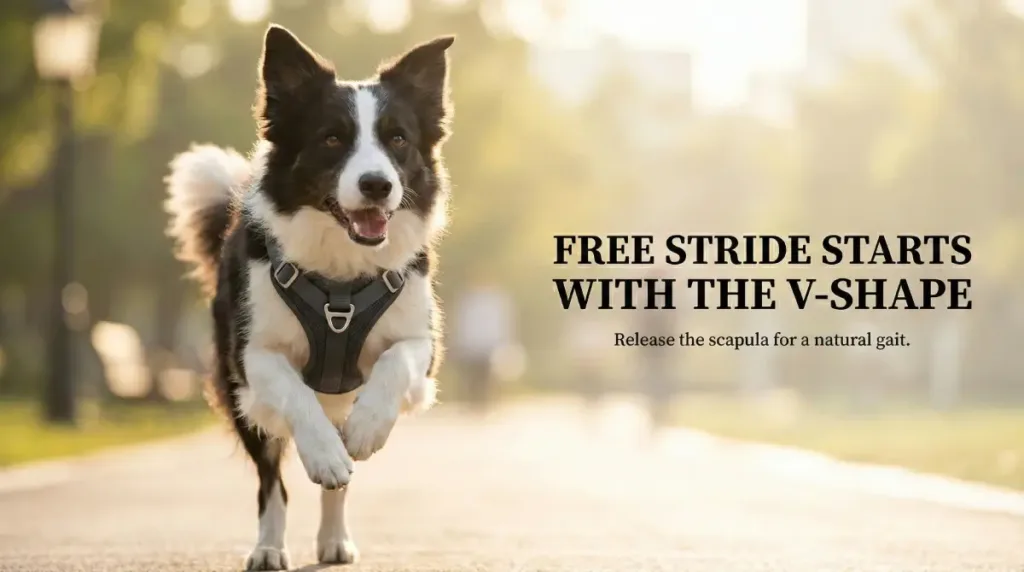
- The Better Option: Look for a design where the neck straps make a deep ‘V’ shape. It should rest on the breastbone. This leaves the shoulder blades free to glide.
The Bottom Line
Your dog can’t tell you if their gear pinches. They can’t say, “Hey, this strap hurts my shoulder.”
It is up to us.
So, before your next walk, take thirty seconds. Check the signs of ill-fitting harness.
- Check the armpits.
- Check the snugness.
- Watch the stride.
Does your current gear pass the test? If not, do your best friend a favor. Look for a modern, ergonomic Y-harness. Their joints will thank you.
Happy Walking!
Frequently Asked Questions
Q1. How tight should a dog harness really be?
A: Use the “Two-Finger Rule.” Can you easily slide two fingers under every strap? Good. If your fingers get stuck, it is too tight. If you can fit your whole hand underneath? It is way too loose. You want it snug, but not strangling.
Q2. Why is a “Y-harness” better than a strap across the chest?
A: It is all about movement. A horizontal chest strap sits right on top of the shoulder joints. It physically blocks the front legs from extending fully. A Y-harness sits between the neck and the sternum. This leaves the shoulders totally free to move naturally.
Q3. My dog hides when I pick up the harness. Does it fit wrong?
A: That is a huge clue. Dogs are smart. If the gear pinches or rubs their armpits, they remember the pain. If they run away or freeze when you bring it out, check the fit immediately. It might be causing dog harness chafing that you can’t see yet.