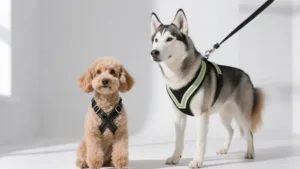
In the pet supplies industry, when it comes to “deep-chested dogs,” breeds like Greyhounds, Dobermans, Weimaraners, Whippets, and Boxers—dogs with naturally long, slender bodies, deep chests, and narrow waists—present unique challenges in the harness market.
However, in recent years, with the rise of customized pet gear, deep-chested dog harnesses have entered a new phase: not simply “larger sizes,” but a comprehensive upgrade focusing on structure, materials, function, comfort, and personalization.
This article will take you through the most noteworthy trends in the deep-chested dog harness market from an industry perspective.
—1. Why is “Fit” the Most Important Trend This Year?
Many people don’t know that the typical body shape of deep-chested dogs—deep chest, narrow waist, and long back—makes them particularly prone to “backing out” of traditional H-shaped harnesses.
It’s not that the harness isn’t tightened enough, but rather that the structure is inherently incompatible. Because of this, “more precise fit + more adjustment points” has become the most obvious trend in this category.
3-point and 5-point adjustable structures are becoming standard
The most popular deep-chested dog harnesses on the market now almost all have the following features:
- Independently adjustable neck structure to avoid throat pressure
- Adjustable Y-shaped chest area to accommodate prominent breastbones
- Adjustable “rear waist strap” to secure the narrow waist of deep-chested dogs
- An additional “anti-escape safety strap” (a third rear waist strap)
The surge in demand for these types of products has also driven more brands to focus on “precision structure + safety logic.”
—2. Which Harness Structures are the Most Popular?
1. Why are Y-shaped harnesses so friendly to deep-chested dogs
Because their characteristics—no shoulder pressure, no restriction of stride, and reasonable force distribution—better fit the structure of long breastbones, allowing the harness to be secure without constricting the throat, making it the “golden structure” for deep-chested dogs.
2. Tactical style is also very popular with users
In recent years, the tactical style has also become very popular in the pet industry. The MOLLE system (for attaching accessories) is particularly popular with outdoor enthusiasts and owners of large dogs: it can hold water bottles, treat pouches, ID tags, lights, and GPS devices, allowing for seamless transitions between different activities.
For deep-chested dogs, these harnesses are not only structurally stable but also offer flexible customization depending on the situation, making them a typical “function equals value” product.
3. Specialized Harnesses for Specific Dog Breeds
For slender dogs with thin skin and delicate fur, such as Whippets and Greyhounds, functionality alone isn’t enough; the harness must also be non-chafing, non-constricting, non-slipping, and non-wobbling.
The trend for these harnesses is lightweight and minimalist design, soft lining (lambswool, soft neoprene), extended chest straps to prevent slippage, and ultra-high adjustability to fit their “aerodynamic physique.”
The industry generally believes this market segment will continue to grow.
—3. Materials and Personalization are also Industry Trends
With the increasing popularity of dog sports, hiking, and cycling with dogs, our research shows that users are paying more attention to materials:
- Breathable mesh fabric: for deep-chested dogs with high activity levels, preventing overheating
- Neoprene padding: reduces friction
- High-strength nylon webbing: lightweight but not easily broken
These materials are common in professional equipment, but are now becoming standard in everyday harnesses.
In addition, we have observed a clear trend in recent years – harnesses are no longer just tools, but rather “an expression of style for both pet and owner.”
Users appreciate customizable color options (earth tones, neon colors, cream shades, etc.), Velcro name tags, personalized ID patches, direct embroidery of names or phone numbers, QR code digital identity tags, and other “appearance + identity” features, making the harness more like a piece of equipment than an ordinary item.
—4. What is Changing in the Industry?
Small-Batch Customization is Becoming a New Opportunity for Brands
Many factories, including Wingtupet, are starting to offer “semi-customization” services, such as: hardware colors (black, rose gold, gunmetal), webbing colors, leather labels, woven labels, edging, and lining materials. This allows brands to easily create a series with their own unique style without the risk of large-scale production.
Rising Demand for Sustainable Materials
Consumers are increasingly willing to pay for “eco-friendly products,” and Wingtupet’s use of recycled PET webbing, environmentally friendly dyeing and finishing, and recycled foam lining in its high-end pet gear is clearly becoming a competitive advantage.
Regarding Sizing
Sizing for deep-chested dogs is particularly challenging; traditional S/M/L sizes are simply insufficient.
More and more brands, including Wingtupet, are starting to use average chest/waist measurements for different dog breeds and big data analysis of “most common fitting issues” to create more accurate breed-specific sizing.
Once perfected, this data-driven sizing strategy will significantly reduce return rates.
—5. Future Outlook: 3D Scanning for Custom Harnesses is Approaching
Currently, some in the industry believe that within the next 3-5 years:
3D body scanning, AI-powered harness template generation, and fully automated cutting technologies will gradually enter the high-end market.
For deep-chested dogs, this will be a historic change:
For the first time, truly “custom-fitted harnesses” will be possible.
Conclusion
Today, harness design for deep-chested dogs has evolved from a “product” to a “solution.”
It needs to be safe, non-slip, non-choking, adjustable, and customizable, and the industry is constantly upgrading along this logic.
For brands, factories, and retailers—
Harnesses for deep-chested dogs represent a golden opportunity with stable demand, significant growth, high return rates, but even greater potential for improvement.
For users—
Choosing a “truly well-fitting” harness is not just about aesthetics, but a long-term investment in safety and comfort.